
Security teams use Cypho to spot external risk earlier.
Financial services firms, government agencies, energy companies, healthcare organizations and technology companies use Cypho to watch what sits outside their perimeter. Each finding is verified before it reaches the team, with enough context to decide what to do about it.
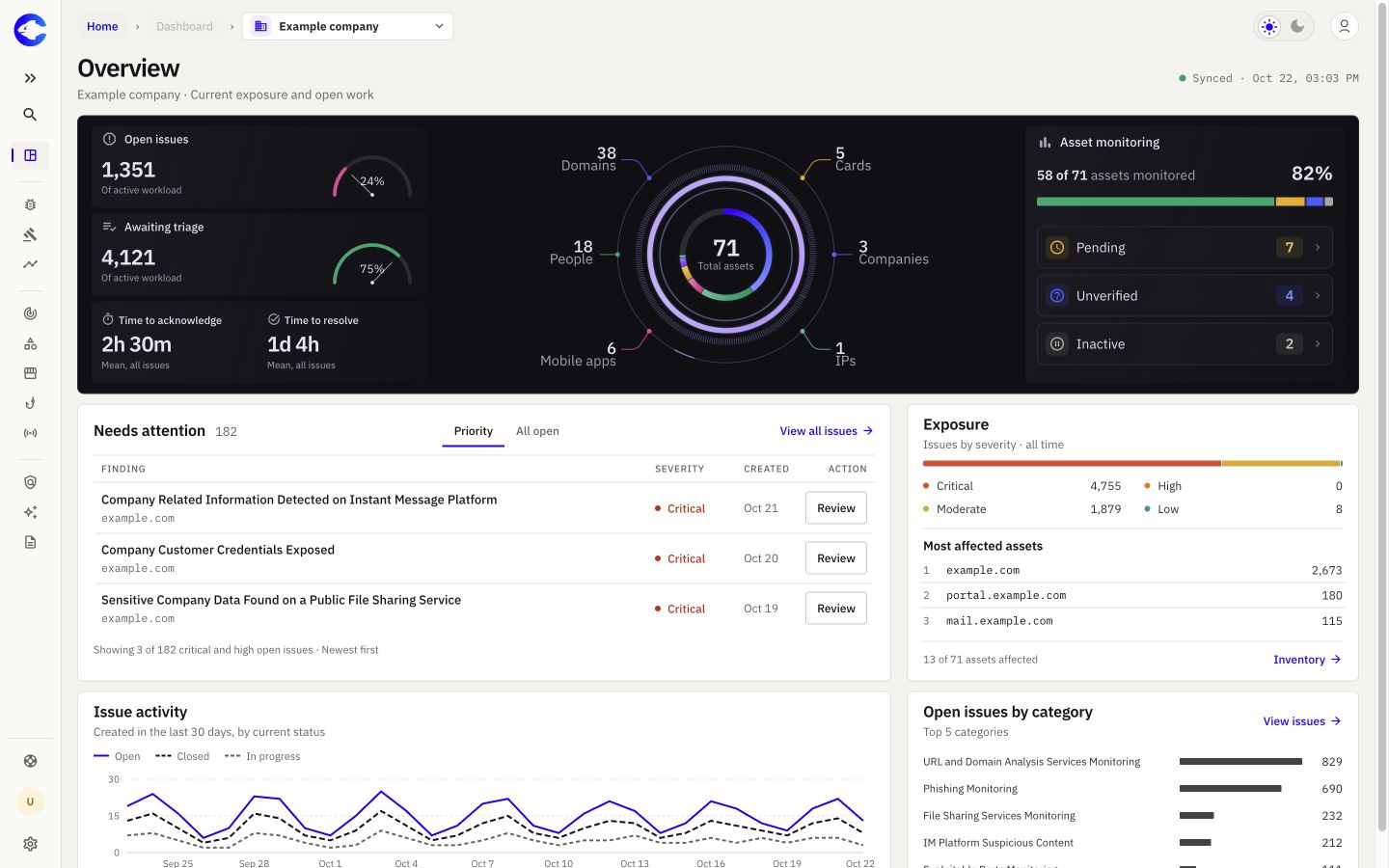
The risk often sits where internal tools can't see.
In several of our customer stories, the exposure turned up somewhere the organization's own controls didn't reach: a public API repository, a Telegram channel, a stealer log, a new web page carrying its name and logo.
Most of these teams work in high-trust environments: financial services, public services, healthcare, critical infrastructure. A leaked credential or a page copying their logo is a security problem and a trust problem at the same time.
They use Cypho to watch those places continuously, and to get a short list of verified findings instead of a feed they have to sort through themselves.
Watch everything outside, then work on what matters.
Continuous visibility
One view across the surface, deep and dark web. Monitoring doesn't stop between assessments, so new exposure is picked up as it appears instead of at the next periodic review.
Intelligence that prioritizes
AI-assisted context helps teams focus on what matters now. Every finding is verified and carries a severity, so a real credential leak doesn't wait in the same queue as a routine public reference.
Built for security operations
Findings are designed to move into the workflows you already run. Each one arrives as a ticket with its source, evidence and remediation guidance, and stays tracked until it's closed.
Give every alert the context it needs.
We bring exposure, actor, infrastructure and credential intelligence together, so analysts investigate faster and explain risk from a shared source of truth.
- 1
External signal
Something tied to you turns up: a login portal on the open internet, your brand in a Telegram channel, an employee password in a stealer log.
- 2
Verified
The finding is checked before it reaches your team, so analysts don't spend time working out whether it's real.
- 3
Prioritized context
It arrives as one ticket with the source, the evidence, a severity and remediation guidance.
- 4
Decision
Your team restricts access, rotates credentials, patches, reports for takedown or accepts the risk, and the issue is tracked until it's closed.
Different sectors face different adversaries.
We bring each team the external intelligence, exposure context and workflow support its sector calls for.
- Financial services
- Surface credential exposure, fraud signals and external risks before they reach critical systems.
- Government
- Protect sensitive services with continuous intelligence on targeted threats and criminal infrastructure.
- Retail and eCommerce
- Detect impersonation, phishing, account takeover and fraud aimed at your customers.
- Oil, gas and energy
- Identify targeted threats and supply-chain exposure before they disrupt essential operations.
- Telecom
- Monitor exposed services, misconfigurations and adversary activity across complex networks.
- Healthcare
- Protect patient data and digital services from leaks, attacks and brand impersonation.
The kinds of exposure our customers dealt with.
The stories leave out customer names but keep the details: what was exposed, how it was found and what the team did about it.
B / Attack Surface Management
Exposed services and infrastructure
A firewall management portal and a webmail login reachable from the internet. Domain, IP and certificate details indexed by public reconnaissance sites. Teams checked what really needed to be public and reviewed access controls.
B / Attack Surface Management
Application weaknesses
A verified SQL injection in an internet-facing endpoint, and access control flaws that could let a user open other people's records by changing an identifier. Both led to fixes in how the applications handle input and authorization.
A / Threat Intelligence
Vulnerable DNS software
Several high-severity CVEs in an open-source DNS server. Cypho laid out affected versions, severity and the fix for each, so the team could focus on the issues most likely to disrupt DNS and plan the update to a fixed version.
A / Threat Intelligence
Secrets and API details in public code
A government agency found credentials committed to a public GitHub repository and rotated them. A financial-services organization found banking API schemas with example account data on SwaggerHub and investigated what they exposed.
A / Threat Intelligence
Credentials in stealer logs
An employee's corporate credentials in stealer logs. The team reset the password, reviewed sign-in activity and checked whether anyone had used the account.
C / Brand Protection
Brand misuse
A web page using a government organization's name and logo, and a Telegram account that appeared to sell access tied to a payment brand. The Telegram case was closed within 15 days, after the account was deleted.
Every customer story.
Each one covers the exposure a team found, what they did about it and what changed.
- Energy Reducing Attack Surface Exposure: Securing Administrative Interfaces in Energy Infrastructure An energy company used Cypho to identify exposed administrative interfaces, prioritize remediation, and reduce external attack surface risk.
- Financial services Securing Exposed API Schemas: Lessons from a Banking Repository Incident A financial services organization used Cypho to identify exposed API schema information in a public repository and reduce integration security risk.
- Financial services From Dark Web Signal to Resolution: Investigating a Financial Brand Threat on Telegram A financial services organization used Cypho to investigate a Telegram-based brand threat, validate risk, and coordinate response.
- Government Verified Brand Impersonation Detection: Protecting Public Trust in a Government Digital Presence A government organization used Cypho to detect verified brand impersonation, investigate unauthorized web content, and protect public trust.
- Government Strengthening External Infrastructure Visibility for Public Sector Digital Services A government organization used Cypho to improve visibility into external infrastructure signals, public references, and digital risk.
- Government Secret Exposure in Public Repositories: A Government Agency's Path to Rapid Containment A government agency used Cypho to identify exposed secrets in a public repository, rotate compromised credentials, and strengthen repository governance.
- Healthcare Identifying and Remediating SQL Injection Risk in a Healthcare Application A healthcare organization used Cypho to detect a verified SQL injection vulnerability, strengthen secure database interaction, and reduce risk to sensitive healthcare data.
- Healthcare Access Control Failures in Healthcare Applications: A Case for Continuous Monitoring A healthcare organization used Cypho Attack Surface Management to identify improper access control weaknesses, improve authorization logic, and protect sensitive patient information.
- DNS security Prioritizing Critical DNS Vulnerabilities: A Framework for Infrastructure Risk Reduction An organization used Cypho to identify DNS infrastructure risk, prioritize vulnerable services, and improve remediation workflows.
- Technology Credential Exposure in Stealer Logs: A Proactive Response to Corporate Account Risk A technology company used Cypho to identify credential exposure in stealer logs, assess account risk, and strengthen identity protection.
What customers found.
Customer stories
- Energy Reducing Attack Surface Exposure: Securing Administrative Interfaces in Energy Infrastructure An energy company used Cypho to identify exposed administrative interfaces, prioritize remediation, and reduce external attack surface risk.
- Technology Credential Exposure in Stealer Logs: A Proactive Response to Corporate Account Risk A technology company used Cypho to identify credential exposure in stealer logs, assess account risk, and strengthen identity protection.
- Government Verified Brand Impersonation Detection: Protecting Public Trust in a Government Digital Presence A government organization used Cypho to detect verified brand impersonation, investigate unauthorized web content, and protect public trust.
Unknown threats are unstoppable. Until we expose them.
Send us your company domain. We'll walk you through what's already out there about you and how Cypho would handle it, with one of our analysts on the call.
Or write to [email protected]